P.S. Free 2025 SAP C_ABAPD_2309 dumps are available on Google Drive shared by ExamDumpsVCE: https://drive.google.com/open?id=1KuUqztH3iEZX3U1ENZvexgZIGIL3sJsU
If you buy our C_ABAPD_2309 exam questions, we will offer you high quality products and perfect after service just as in the past. We believe our consummate after-sale service system will make our customers feel the most satisfactory. Our company has designed the perfect after sale service system for these people who buy our C_ABAPD_2309 practice materials. We can always give the most professinal suggestion on our C_ABAPD_2309 learning guide to our customers at the first time for our service are working 24/7 online.
If you choose our C_ABAPD_2309 study materials and use our products well, we can promise that you can pass the C_ABAPD_2309 exam and get the C_ABAPD_2309 certification. Then you will find you have so many chances to advance in stages to a great level of social influence and success. Our C_ABAPD_2309 Guide Torrent can also provide all candidates with our free demo, in order to exclude your concerts that you can check our C_ABAPD_2309 exam questions. We believe that you will be fond of our C_ABAPD_2309 learning guide.
>> Exam SAP C_ABAPD_2309 Price <<
There are more opportunities for possessing with a certification, and our C_ABAPD_2309 study materials are the greatest resource to get a leg up on your competition, and stage yourself for promotion. When it comes to our time-tested C_ABAPD_2309 study materials, for one thing, we have a professional team contains a lot of experts who have devoted themselves to the research and development of our C_ABAPD_2309 Study Materials, thus we feel confident enough under the intensely competitive market. For another thing, conforming to the real exam our C_ABAPD_2309 study materials have the ability to catch the core knowledge.
| Topic | Details |
|---|---|
| Topic 1 |
|
| Topic 2 |
|
| Topic 3 |
|
| Topic 4 |
|
| Topic 5 |
|
NEW QUESTION # 45
You have attached a system field to an input parameter of a CDS view entity as follows:
What are the effects of this annotation? Note: There are 2 correct answers to this question.
Answer: A,B
Explanation:
The annotation @Environment.systemField: #LANGUAGE is used to assign the ABAP system field sy-langu to an input parameter of a CDS view or a CDS table function. This enables the implicit parameter passing in Open SQL, which means that the value of sy-langu will be automatically passed to the CDS view without explicitly specifying it in the WHERE clause. This also applies to the CDS views that use the annotated CDS view as a data source, which means that the value of sy-langu will be propagated to the nested CDS views (view on view)12. For example:
* The following code snippet defines a CDS view ZI_FLIGHT_TEXTS with an input parameter p_langu that is annotated with @Environment.systemField: #LANGUAGE:
define view ZI_FLIGHT_TEXTS with parameters p_langu : syst_langu @<Environment.systemField:
#LANGUAGE as select from sflight left outer join scarr on sflight.carrid = scarr.carrid left outer join stext on scarr.carrid = stext.carrid { sflight.carrid, sflight.connid, sflight.fldate, scarr.carrname, stext.text as carrtext } where stext.langu = :p_langu
* The following code snippet shows how to use the CDS view ZI_FLIGHT_TEXTS in ABAP without specifying the value of p_langu in the WHERE clause. The value of sy-langu will be automatically passed to the CDS view:
SELECT carrid, connid, fldate, carrname, carrtext FROM zi_flight_texts INTO TABLE @DATA(lt_flights).
* The following code snippet shows how to use the CDS view ZI_FLIGHT_TEXTS in another CDS view ZI_FLIGHT_REPORT. The value of sy-langu will be automatically passed to the nested CDS view ZI_FLIGHT_TEXTS:
define view ZI_FLIGHT_REPORT with parameters p_langu : syst_langu @<Environment.systemField:
#LANGUAGE as select from zi_flight_texts(p_langu) { carrid, connid, fldate, carrname, carrtext, count(*) as flight_count } group by carrid, connid, fldate, carrname, carrtext The annotation @Environment.systemField: #LANGUAGE does not prevent the possibility of overriding the default value with a value of your own. You can still specify a different value for the input parameter p_langu in the WHERE clause, either in ABAP or in another CDS view. This will override the value of sy-langu and pass the specified value to the CDS view12. For example:
* The following code snippet shows how to use the CDS view ZI_FLIGHT_TEXTS in ABAP with a specified value of p_langu in the WHERE clause. The value 'E' will be passed to the CDS view instead of the value of sy-langu:
SELECT carrid, connid, fldate, carrname, carrtext FROM zi_flight_texts WHERE p_langu = 'E' INTO TABLE @DATA(lt_flights).
* The following code snippet shows how to use the CDS view ZI_FLIGHT_TEXTS in another CDS view ZI_FLIGHT_REPORT with a specified value of p_langu in the WHERE clause. The value 'E' will be passed to the nested CDS view ZI_FLIGHT_TEXTS instead of the value of sy-langu:
define view ZI_FLIGHT_REPORT with parameters p_langu : syst_langu @<Environment.systemField:
#LANGUAGE as select from zi_flight_texts(p_langu) { carrid, connid, fldate, carrname, carrtext, count(*) as flight_count } where p_langu = 'E' group by carrid, connid, fldate, carrname, carrtext References: 1: ABAP CDS - parameter_annot - ABAP Keyword Documentation - SAP Online Help 2: ABAP CDS - session_variable - ABAP Keyword Documentation - SAP Online Help
NEW QUESTION # 46
Which ABAP SQL clause allows the use of inline declarations?
Answer: D
Explanation:
Explanation
The ABAP SQL clause that allows the use of inline declarations is the INTO clause. The INTO clause is used to specify the target variable or field symbol where the result of the SQL query is stored. The INTO clause can use inline declarations to declare the target variable or field symbol at the same position where it is used, without using a separate DATA or FIELD-SYMBOLS statement. The inline declaration is performed using the DATA or @DATA operators in the declaration expression12. For example:
The following code snippet uses the INTO clause with an inline declaration to declare a local variable itab and store the result of the SELECT query into it:
SELECT * FROM scarr INTO TABLE @DATA (itab).
The following code snippet uses the INTO clause with an inline declaration to declare a field symbol
<fs> and store the result of the SELECT query into it:
SELECT SINGLE * FROM scarr INTO @<fs>.
You cannot do any of the following:
FROM: The FROM clause is used to specify the data source of the SQL query, such as a table, a view, or a join expression. The FROM clause does not allow the use of inline declarations12.
INTO CORRESPONDING FIELDS OF: The INTO CORRESPONDING FIELDS OF clause is used to specify the target structure or table where the result of the SQL query is stored. The INTO CORRESPONDING FIELDS OF clause does not allow the use of inline declarations. The target structure or table must be declared beforehand using a DATA or FIELD-SYMBOLS statement12.
FIELDS: The FIELDS clause is used to specify the columns or expressions that are selected from the data source of the SQL query. The FIELDS clause does not allow the use of inline declarations. The FIELDS clause must be followed by an INTO clause that specifies the target variable or field symbol where the result is stored12.
References: 1: SELECT - ABAP Keyword Documentation - SAP Online Help 2: Inline Declarations - ABAP Keyword Documentation - SAP Online Help
NEW QUESTION # 47
You have a superclass superl and a subclass subl of superl. Each class has an instance constructor and a static constructor. The first statement of your program creates an instance of subl. In which sequence will the constructors be executed?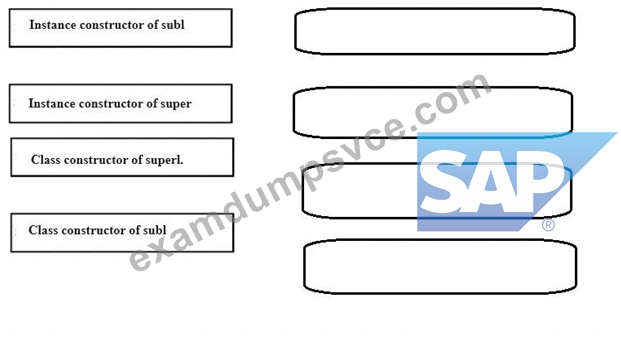
Answer:
Explanation: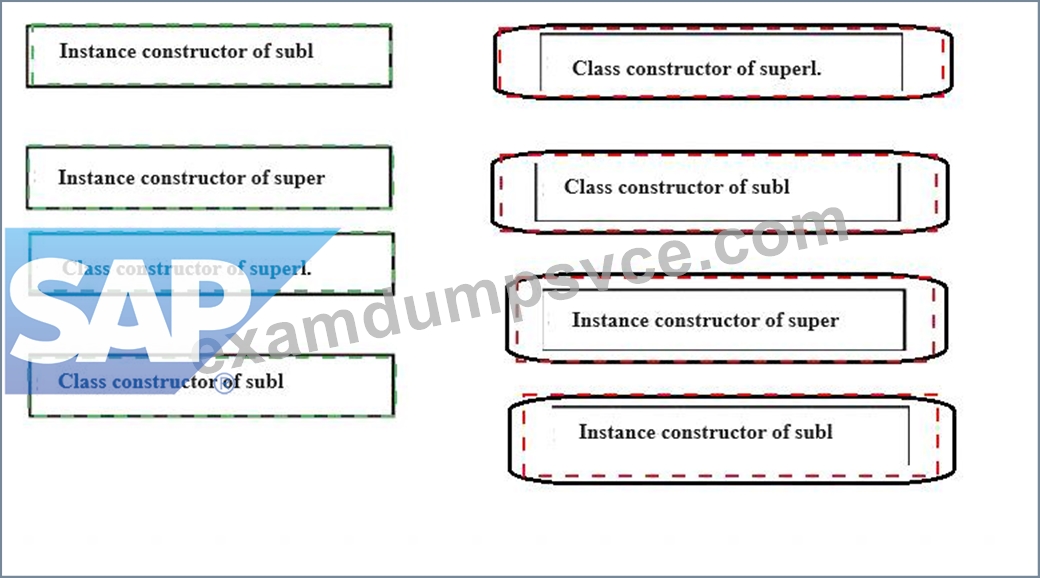
Explanation:
The sequence in which the constructors will be executed is as follows:
* Class constructor of superl. This is because the class constructor is a static method that is executed automatically before the class is accessed for the first time. The class constructor is used to initialize the static attributes and components of the class. The class constructor of the superclass is executed before the class constructor of the subclass, as the subclass inherits the static components of the superclass12
* Class constructor of subl. This is because the class constructor is a static method that is executed automatically before the class is accessed for the first time. The class constructor is used to initialize the static attributes and components of the class. The class constructor of the subclass is executed after the class constructor of the superclass, as the subclass inherits the static components of the superclass12
* Instance constructor of superl. This is because the instance constructor is an instance method that is executed automatically when an instance of the class is created using the statement CREATE OBJECT.
The instance constructor is used to initialize the instance attributes and components of the class. The instance constructor of the superclass is executed before the instance constructor of the subclass, as the subclass inherits the instance components of the superclass. The instance constructor of the subclass must call the instance constructor of the superclass explicitly using super->constructor, unless the superclass is the root node object12
* Instance constructor of subl. This is because the instance constructor is an instance method that is executed automatically when an instance of the class is created using the statement CREATE OBJECT.
The instance constructor is used to initialize the instance attributes and components of the class. The instance constructor of the subclass is executed after the instance constructor of the superclass, as the subclass inherits the instance components of the superclass. The instance constructor of the subclass must call the instance constructor of the superclass explicitly using super->constructor, unless the superclass is the root node object12 References: Constructors of Classes - ABAP Keyword Documentation, METHODS - constructor - ABAP Keyword Documentation
NEW QUESTION # 48
What are advantages of using a field symbol for internal table row access? Note: There are answers to this question.
Answer: A,B
Explanation:
Explanation
A field symbol is a pointer that allows direct access to a row of an internal table without copying it to a work area. Using a field symbol for internal table row access has some advantages over using a work area, such as12:
A MODIFY statement to write changed contents back to the table is not required: This is true. When you use a work area, you have to copy the row content from the internal table to the work area, modify it, and then copy it back to the internal table using the MODIFY statement. This can be costly in terms of performance and memory consumption. When you use a field symbol, you can modify the row content directly in the internal table without any copying. Therefore, you do not need the MODIFY statement12.
Using a field symbol is faster than using a work area: This is true. As explained above, using a field symbol avoids the overhead of copying data between the internal table and the work area. This can improve the performance of the loop considerably, especially for large internal tables. According to some benchmarks, using a field symbol can save 25-40% of the runtime compared to using a work area12.
You cannot do any of the following:
The field symbol can be reused for other programs: This is false. A field symbol is a local variable that is only visible within the scope of its declaration. It cannot be reused for other programs unless it is declared globally or passed as a parameter. Moreover, a field symbol must have the same type as the line type of the internal table that it accesses. Therefore, it cannot be used for any internal table with a different line type12.
The row content is copied to the field symbol instead to a work area: This is false. As explained above, using a field symbol does not copy the row content to the field symbol. Instead, the field symbol points to the memory address of the row in the internal table and allows direct access to it. Therefore, there is no copying involved when using a field symbol12.
References: 1: Using Field Symbols to Process Internal Tables - SAP Learning 2: Access to Internal Tables - ABAP Keyword Documentation - SAP Online Help
NEW QUESTION # 49
For what kind of applications would you consider using on-stack developer extensions? Note: There are 2 correct answers to this question.
Answer: A,B
Explanation:
On-stack developer extensibility is a type of extensibility that allows you to create development projects directly on the SAP S/4HANA Cloud technology stack. It gives you the opportunity to develop cloud-ready and upgrade-stable custom ABAP applications and services inside the SAP S/4HANA Cloud, public edition system. You can use the ABAP Development Tools in Eclipse to create and deploy your on-stack extensions.
On-stack developer extensibility is suitable for the following kinds of applications:
* Applications that provide APIs for side by side SAP BTP apps. On-stack developer extensibility allows you to create OData services or RESTful APIs based on CDS view entities or projection views. These services or APIs can expose SAP S/4HANA data and logic to other applications that run on the SAP Business Technology Platform (SAP BTP) or other platforms. This way, you can create a loosely coupled integration between your SAP S/4HANA system and your side by side SAP BTP apps.
* Applications that access SAP S/4HANA data using complex SQL. On-stack developer extensibility allows you to use ABAP SQL to access SAP S/4HANA data using complex queries, such as joins, aggregations, filters, parameters, and code pushdown techniques. You can also use ABAP SQL to perform data manipulation operations, such as insert, update, delete, and upsert. This way, you can create applications that require advanced data processing and analysis on SAP S/4HANA data.
The other kinds of applications are not suitable for on-stack developer extensibility, as they have different requirements and challenges. These kinds of applications are:
* Applications that integrate data from several different systems. On-stack developer extensibility is not meant for creating applications that integrate data from multiple sources, such as other SAP systems, third-party systems, or cloud services. This is because on-stack developer extensibility does not support remote access or data replication, and it may cause performance or security issues. For this kind of applications, you should use side by side extensibility, which allows you to create applications that run on the SAP BTP and communicate with the SAP S/4HANA system via public APIs or events.
* Applications that run separate from SAP S/4HANA. On-stack developer extensibility is not meant for creating applications that run independently from the SAP S/4HANA system, such as standalone apps, microservices, or web apps. This is because on-stack developer extensibility requires a tight coupling with the SAP S/4HANA system, and it may limit the scalability, flexibility, and portability of the applications. For this kind of applications, you should use side by side extensibility, which allows you to create applications that run on the SAP BTP and leverage the cloud-native features and services of the platform.
References: Developer Extensibility in SAP S/4HANA Cloud ABAP Environment, SAP S/4HANA Extensibility - Simplified Guide for Beginners
NEW QUESTION # 50
......
With C_ABAPD_2309 test training materials of ExamDumpsVCE, you will own the key to pass C_ABAPD_2309 exam, which will make you develop better in IT. All of this just need you trust us, trust in ExamDumpsVCE, and trust in C_ABAPD_2309 test training materials. Our training material of C_ABAPD_2309 exam is absolutely real and reliable. What's more, the passing rate of C_ABAPD_2309 test is as high as 100%.
C_ABAPD_2309 Exam Reviews: https://www.examdumpsvce.com/C_ABAPD_2309-valid-exam-dumps.html
2025 Latest ExamDumpsVCE C_ABAPD_2309 PDF Dumps and C_ABAPD_2309 Exam Engine Free Share: https://drive.google.com/open?id=1KuUqztH3iEZX3U1ENZvexgZIGIL3sJsU

An online Education platform for full course of tutorials available in all different categories.